I'm pleased to announce the publication of the online Guide to US History Sources, on the Bodleian Libraries' LibGuides site. This guide replaces the old yellow paper versions which used to be available in the library, and provides links to and information about a whole variety of resources available for research in US History.
The web address for the guide is http://ox.libguides.com/ushistory. The benefits of an online guide are that the links to e-resources are active (if you're not connected to the University network you will need to sign in on SOLO first), and the guide can be easily and frequently updated. Hopefully it will provide you with an excellent starting point for your research. Please feel free to make suggestions about more resources to include, or if the guide could be made more user-friendly. We also have a separate online guide available for US Government Publications, and could potentially create further specific guides in the future.
The online guide is designed to be complemented by this blog, which will continue to go into more depth about individual resources and topics. I'm also always happy to help you if you have questions about resources available either in the library or online.
Thursday, 5 May 2011

Friday, 15 April 2011
April 15, 1912: Sinking of the Titanic
A quick post this one, to point you in the direction of an interesting document we have available in the US Congressional Serial Set. If you came to the talk on the Serial Set by August Imholtz from Readex in January you'll have seen this before, and we've had it out on display a couple of times, so it may already be familiar. It is however an example of the way that the Serial Set contains documents and primary sources for a huge range of historical events.
 Following the sinking of the Titanic on April 15, 1912, the US Senate's Committee on Commerce held a series of hearings into the disaster. The Committee was directed by S.Res 283 'to investigate the causes leading to the wreck', and a large number of people testified, including eye-witness accounts of the disaster itself. One of these accounts, from a Mrs Emily Ryerson, a passenger on the boat, was used as a source for the 1997 film. The full hearings document runs to 1170 pages, and you can also access the (much briefer!) final report, submitted to Congress on May 28.
Link to the full hearings [Oxford users only] Mrs Ryerson's testimony is on pages 1107 and 1108.
Link to the full report [Oxford users only]


I'll be writing a fuller post on the Serial Set, what it contains and how to use it, in due course! If you're curious in the meantime though, there is a slideshow presentation embedded on our online US Government Publications Guide (click on the 'Legislative/Congressional' tab and then scroll down the page).

Link to the full hearings [Oxford users only] Mrs Ryerson's testimony is on pages 1107 and 1108.
Link to the full report [Oxford users only]


I'll be writing a fuller post on the Serial Set, what it contains and how to use it, in due course! If you're curious in the meantime though, there is a slideshow presentation embedded on our online US Government Publications Guide (click on the 'Legislative/Congressional' tab and then scroll down the page).
Tuesday, 8 March 2011
North American Women's Letters and Diaries
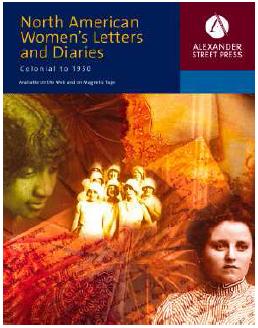
The database creators had strict criteria for deciding whether to include material:
- Authors must be women and must have been resident in North America for a significant time.
- Materials must have been written contemporaneously. Autobiographical material are excluded, unless they are considered of particular value.
- Memoirs are included when they are of particular value.
- Collections of letters begun before 1950 are included until they are complete. Collections of letters written after 1950 are excluded.
- Diaries that began before 1950 are included until they are complete. Diaries that began after 1950 are excluded.
- Letters written by men are excluded.
Using the database
There is a variety of ways to access the material within the database. In the top menu bar are the options to browse, find and search. The first few browse options and the simple search are pretty straightforward (browse by author, source, year, and simple full-text keyword search with some options to limit your results by author, year, document type etc), however this database offers some really nice other search/browse options that provide a different way to find material.
Under browse you will find options to browse by place (which also demonstrates that the material in this database has a much wider geographical interest than just North America, even if the authors are all American), historical events (eg Salem Witch Trials, Lincoln's assassination, the sinking of the Titanic), and personal events (death of child, emigration, religious experience, starting a job). There is also a showcase of a few selected documents of interest.
The difference between find and search is basically whether you are trying to find documents themselves, or search within them. Under 'find' you have the option to search for sources (ie, the documents) or authors. Searching for sources will only search on the bibliographic information attached to that document, and will bring you to the record (from where you can click through to the full text). Searching for authors is useful both when you're trying to find a known author (for which there is also an alphabetical browse index at the top of the search screen), and if you're trying to find authors that match certain criteria - ie, from a certain time period, place, ethnicity, religion etc. By each search box in all the different search screens is a 'terms' button, which will bring up a list of all the terms available in the index that you can select and add to your search - this also effectively offers you another way to browse, or restrict your search to specific subsets of the database.
The search menu options allow you to search within the text of the documents. As well as the usual simple and advanced search options, there are also options to specifically search either letters or diaries, and each search can be limited by a whole variety of different terms. The advanced search is particularly good if you want to search for something very specific (eg, restricting your search to letters written on military bases). The advanced search option also allows you to specify a proximity range for more than one search term. These incredibly detailed search options are a particular strength of this resource.
Where this resource is not quite so amazing is in what you can do with the results when you get them. Most of the documents are available only as transcriptions, not page images, although there are some page images available. There also aren't any save, export, or print options, so all you can really do is copy & paste or print directly from your browser (though bear in mind the fact that most of the material is still under copyright, so fair dealing principles apply). You can however easily click through from the bibliographic records to other documents by the same author or in the same source, as well as access the author's biography (where available).
For more information about this resource, see the publisher's description at: http://alexanderstreet.com/products/nwld.htm.
Thursday, 24 February 2011
African American History Resources, Part Two: pre-20th century, slavery, emancipation etc
To follow up my previous post listing some of the resources we have available for African American history in the 20th century, here I'll set out some of the resources we have for earlier time periods, in particular related to slavery/anti-slavery, emancipation, and the Civil War (another core area of our collection). My period-division here has been very rough, just to avoid having an enormously long post, so some of the resources listed here will reach into the 20th century, and I will also not repeat resources here from my previous post that do cover earlier periods (especially our government publications and newspaper resources).
Microfilm and archival collections
The Freedmen's Aid Society Records cover 1866-1932, and extend to 120 reels of microfilm (guide available at Micr. BX 8235 .F74 2000). The Freedman's Aid Society was originally founded as the Fugitives' Aid Society with the aim to assist fugitive slaves and to lobby and protest against slavery in the United States. With the signing of the Emancipation Proclamation, the Fugitives' Aid Society became the Freedmen's Aid Society. The organisation sent money and volunteer aid to the South after the defeat of the Confederacy. They also had a strong education initiative and was responsible for the establishment of many historically Black colleges and universities.
One of the major archival collections held in Rhodes House Library (next door) are the Papers of the (British) Anti-Slavery Society. This society, founded in 1835, had as its aim the abolition of slavery throughout the world in general and in the United States in particular. It convened the first World Anti-Slavery Convention, held in London in June 1840, at which some fifty leading American abolitionists were present. After 1840 the society's transatlantic prestige declined and a second convention held in 1843 attracted only a few American delegates. The Society continued to concern itself with American problems and correspond with American abolitionists up to the Civil War but it was affected by the divisions in the American movement and there came a realisation that it could do little to affect the outcome of the Americn situation. If you're interested in consulting papers from this archive, contact staff in Rhodes House Library. See http://www.bodley.ox.ac.uk/dept/scwmss/wmss/online/blcas/anti-slavery-society.html for more information.
Another archival collection held at Rhodes House is that of the United Society for the Propagation of the Gospel, which was founded in 1701 as a result of an enquiry into the state of the Church of England in the American colonies. Its remit was broadened to encompass evangelisation of slaves and Native Americans. More information can be found at http://www.mundus.ac.uk/cats/11/1052.htm, and again, if you want to consult this archive, contact staff in Rhodes House Library.
In addition to these papers of societies, we have several microfilm collections of the papers of individuals who were active in American politics in the mid-19th century, and which will include material on slavery and emancipation to a greater or lesser extent. These are the papers of James Buchanan (Micr. USA 458), Salmon P. Chase (Micr. USA 331), William H. Seward (Micr. USA 346), and Thaddeus Stevens (Micr. USA 353). Abraham Lincoln's papers can be found online via the Libary of Congress, who have digitised around 20,000 documents from the 1850s through to Lincoln's death in 1865.
The Records of the American Colonization Society, founded in 1817 to resettle African Americans in West Africa, cover 1792-1964, but the bulk of the material dates from 1823-1912. There is a guide available at Micr. E 448 .U54 1979, and selections of these records are also available online via footnote.com.
On a similar theme, we also have the Records of the Office of the Secretary of the Interior relating to the suppression of the African slave trade and Negro colonization, which is a comprehensive set of government papers on many aspects of executive federal involvement in colonisation between 1854 and 1872. These are on microfilm at Micr. USA 456, and can also be found online via footnote.com.
Online resources
And finally, here's a list of some of the useful free online resources I have come across relating to African American history pre-20th century, slavery, emancipation etc, all saved on our delicious page for future reference:
Credit: some of the text in this post was originally written by the History Librarian, Isabel Holowaty, as I have just borrowed her descriptions where they already existed.
Microfilm and archival collections
The Freedmen's Aid Society Records cover 1866-1932, and extend to 120 reels of microfilm (guide available at Micr. BX 8235 .F74 2000). The Freedman's Aid Society was originally founded as the Fugitives' Aid Society with the aim to assist fugitive slaves and to lobby and protest against slavery in the United States. With the signing of the Emancipation Proclamation, the Fugitives' Aid Society became the Freedmen's Aid Society. The organisation sent money and volunteer aid to the South after the defeat of the Confederacy. They also had a strong education initiative and was responsible for the establishment of many historically Black colleges and universities.
One of the major archival collections held in Rhodes House Library (next door) are the Papers of the (British) Anti-Slavery Society. This society, founded in 1835, had as its aim the abolition of slavery throughout the world in general and in the United States in particular. It convened the first World Anti-Slavery Convention, held in London in June 1840, at which some fifty leading American abolitionists were present. After 1840 the society's transatlantic prestige declined and a second convention held in 1843 attracted only a few American delegates. The Society continued to concern itself with American problems and correspond with American abolitionists up to the Civil War but it was affected by the divisions in the American movement and there came a realisation that it could do little to affect the outcome of the Americn situation. If you're interested in consulting papers from this archive, contact staff in Rhodes House Library. See http://www.bodley.ox.ac.uk/dept/scwmss/wmss/online/blcas/anti-slavery-society.html for more information.
Another archival collection held at Rhodes House is that of the United Society for the Propagation of the Gospel, which was founded in 1701 as a result of an enquiry into the state of the Church of England in the American colonies. Its remit was broadened to encompass evangelisation of slaves and Native Americans. More information can be found at http://www.mundus.ac.uk/cats/11/1052.htm, and again, if you want to consult this archive, contact staff in Rhodes House Library.
In addition to these papers of societies, we have several microfilm collections of the papers of individuals who were active in American politics in the mid-19th century, and which will include material on slavery and emancipation to a greater or lesser extent. These are the papers of James Buchanan (Micr. USA 458), Salmon P. Chase (Micr. USA 331), William H. Seward (Micr. USA 346), and Thaddeus Stevens (Micr. USA 353). Abraham Lincoln's papers can be found online via the Libary of Congress, who have digitised around 20,000 documents from the 1850s through to Lincoln's death in 1865.
The Records of the American Colonization Society, founded in 1817 to resettle African Americans in West Africa, cover 1792-1964, but the bulk of the material dates from 1823-1912. There is a guide available at Micr. E 448 .U54 1979, and selections of these records are also available online via footnote.com.
On a similar theme, we also have the Records of the Office of the Secretary of the Interior relating to the suppression of the African slave trade and Negro colonization, which is a comprehensive set of government papers on many aspects of executive federal involvement in colonisation between 1854 and 1872. These are on microfilm at Micr. USA 456, and can also be found online via footnote.com.
Online resources
And finally, here's a list of some of the useful free online resources I have come across relating to African American history pre-20th century, slavery, emancipation etc, all saved on our delicious page for future reference:
- We Ain't What We Ought To Be: tie-in website for Stephen Tuck's book of the same name, which starts its coverage in 1861. Contains links to lots of online resources and documents mentioned in the book.
- Transatlantic Slave Database: information on some 35,000 slave trading voyages from the 16th-19th centuries.
- The New York African Free School Collection
- Afro-Louisiana History and Genealogy, 1719-1820
- Digital Library on American Slavery
- End of Slavery (Massachusetts Historical Society)
- Texas Slavery Project
- BlackPast.org: online reference guide to African American history
- Frederick Douglass Papers
- Papers of Booker T. Washington, 1856-1915
- Samuel J. May antislavery collection
- The Friend of Man: Digitised newspaper documenting early anti-slavery and other reform movements.
- Map of American Slavery: from the New York Times website's Disunion blog, the United States Coast Survey's map of the slaveholding states, as used by Abraham Lincoln.
- New York Historical Society slavery collections
- The Alfred Whital Stern collection of Lincolniana at the Library of Congress
- Black History on Footnote.com: all free with basic registration
Credit: some of the text in this post was originally written by the History Librarian, Isabel Holowaty, as I have just borrowed her descriptions where they already existed.
Friday, 18 February 2011
African American History Resources, Part One: 20th Century
February is Black History Month, and so I thought I'd put together a couple of blog posts about some of the resources we have available in the library for African American history. Resources for African American history are increasingly a particular strength of the VHL's collection, and with our recent acquisition of the electronic archives of two major black newspapers of the 20th century (The New York Amsterdam News, 1922-1993 and The Pittsburgh Courier, 1911-2002 - see this blog post for more information), we are now the only institution in Western Europe to have access to the archives of three black newspapers. In this first blog post I will focus on 20th century African American history resources, in particular relating to civil rights, and will follow it up (by the end of the month, I promise!) with one on the 19th century and slavery & emancipation.
Newspapers
To start briefly with newspapers and periodicals (but not too extensively, as they were the subject of my last two blog posts), in addition to the three archives mentioned above, we also have a collection of 17 black journals from the first half of the twentieth century available on microfiche (to see which, take a look at our online newspapers-on-microfilm list), as well as an extensive run of the leading African American magazine, Ebony, from 1945-1954 (on microfilm) and then 1958-2008 in print. If you're looking for really recent African American newspapers, then Ethnic NewsWatch (via OxLIP+) provides coverage of ethnic and minority newspapers from 1990 to the present.
For more information on finding newspapers in general, take a look at the previous two posts on this blog.
Microfilm collections
The Civil Rights Era is a particular strength of our collection, and we have several microfilm collections of papers and records relating to the Civil Rights struggle. The Congress of Racial Equality (CORE) Papers cover 1959-1976, and include the records and papers of this organisation, which was founded in 1942 in Chicago and advocated non-violent direct action to address racial discrimination. A guide to the microfilm collection can be found at Micr. E 185.61 .C75455 1984.
We only have selections of the Papers of the NAACP, but even so this is a massive collection of records, speeches, reports, correspondence, branch files and campaign information from the National Association of the Advancement of Colored People. We hold parts 1, 2, 11A, 11B, 12B, 12C, 12D, 26B, 26C, 26D, 28A, 28B, 29A, 29B, 29C, and 29D of this collection (along with guides), which cover a range of topics, locations and dates from 1909-1970.
Another substantial microfilm collection we hold is Civil rights during the Nixon Administration, which record the Nixon administration's broadening of the concept of equal rights beyond desegregation to include affirmative action in hiring women, the elderly, the physically disabled, and an expanding and overlapping list of other groups. Even though the subject matter here is much broader, you will still find records covering the continuing controversy over school desegregation and other topics relating to African American history.
And finally for microfilms, jumping back a little in time, are the Records of the Chicago Commission on Race Relations, which was set up following the riot of July/August 1919 by Illinois governor Frank Lowden.
Government publications and official papers
You can, as expected, find a huge amount of material in our major government publications resources, particularly of course the US Congressional Serial Set (via OxLIP+) where you can browse for publications related to acts such as the Civil Rights Acts of 1964 and 1968 and the Voting Rights Act of 1965, as well as search and browse by subject.
One thing you may not realise that we have though is a lot of the printed civil rights hearings, in particular those before the United States Commission on Civil Rights in the early 1960s - search for civil rights hearings on SOLO. Many of these are down in our stack, so you will need to place a stack request via OLIS to get them fetched up for you.
I will write further blog posts in the future about finding government publications, so keep an eye on the blog for that if you need more guidance.
Books
Just a quick note that the shelfmark range for African Americans in the Library of Congress classification is E 184.5 - E185.98. Obviously you can search SOLO to find out what books we have, but if you want to go and browse the shelves, that's where to head for!
Online resources
As ever, there is a huge and growing amount of fantastic primary source material being made available online. A good starting point is the VHL's delicious page, and the sites we have saved there tagged as African American: http://www.delicious.com/vhllib/African_American. Some particular highlights for the 20th century/civil rights are:
Newspapers
To start briefly with newspapers and periodicals (but not too extensively, as they were the subject of my last two blog posts), in addition to the three archives mentioned above, we also have a collection of 17 black journals from the first half of the twentieth century available on microfiche (to see which, take a look at our online newspapers-on-microfilm list), as well as an extensive run of the leading African American magazine, Ebony, from 1945-1954 (on microfilm) and then 1958-2008 in print. If you're looking for really recent African American newspapers, then Ethnic NewsWatch (via OxLIP+) provides coverage of ethnic and minority newspapers from 1990 to the present.
For more information on finding newspapers in general, take a look at the previous two posts on this blog.
Microfilm collections
The Civil Rights Era is a particular strength of our collection, and we have several microfilm collections of papers and records relating to the Civil Rights struggle. The Congress of Racial Equality (CORE) Papers cover 1959-1976, and include the records and papers of this organisation, which was founded in 1942 in Chicago and advocated non-violent direct action to address racial discrimination. A guide to the microfilm collection can be found at Micr. E 185.61 .C75455 1984.
We only have selections of the Papers of the NAACP, but even so this is a massive collection of records, speeches, reports, correspondence, branch files and campaign information from the National Association of the Advancement of Colored People. We hold parts 1, 2, 11A, 11B, 12B, 12C, 12D, 26B, 26C, 26D, 28A, 28B, 29A, 29B, 29C, and 29D of this collection (along with guides), which cover a range of topics, locations and dates from 1909-1970.
Another substantial microfilm collection we hold is Civil rights during the Nixon Administration, which record the Nixon administration's broadening of the concept of equal rights beyond desegregation to include affirmative action in hiring women, the elderly, the physically disabled, and an expanding and overlapping list of other groups. Even though the subject matter here is much broader, you will still find records covering the continuing controversy over school desegregation and other topics relating to African American history.
And finally for microfilms, jumping back a little in time, are the Records of the Chicago Commission on Race Relations, which was set up following the riot of July/August 1919 by Illinois governor Frank Lowden.
Government publications and official papers
You can, as expected, find a huge amount of material in our major government publications resources, particularly of course the US Congressional Serial Set (via OxLIP+) where you can browse for publications related to acts such as the Civil Rights Acts of 1964 and 1968 and the Voting Rights Act of 1965, as well as search and browse by subject.
One thing you may not realise that we have though is a lot of the printed civil rights hearings, in particular those before the United States Commission on Civil Rights in the early 1960s - search for civil rights hearings on SOLO. Many of these are down in our stack, so you will need to place a stack request via OLIS to get them fetched up for you.
I will write further blog posts in the future about finding government publications, so keep an eye on the blog for that if you need more guidance.
Books
Just a quick note that the shelfmark range for African Americans in the Library of Congress classification is E 184.5 - E185.98. Obviously you can search SOLO to find out what books we have, but if you want to go and browse the shelves, that's where to head for!
Online resources
As ever, there is a huge and growing amount of fantastic primary source material being made available online. A good starting point is the VHL's delicious page, and the sites we have saved there tagged as African American: http://www.delicious.com/vhllib/African_American. Some particular highlights for the 20th century/civil rights are:
- Martin Luther King, Jr. Papers (Stanford University)
- Voices of Civil Rights
- Civil Rights Digital Library
- We Ain't What We Ought To Be: This is a tie-in website for the recently-published book by Stephen Tuck, and includes links to all sorts of free web resources relating to African American history from 1861 to the present that are referred to in the book.
- Documenting the American South
- Civil Rights in Mississippi Digital Archive
- Brown v Board of Education Online Archive
- Martin Luther King Online Encyclopedia
- Television News of the Civil Rights Era
- Black History on Footnote.com: all freely available with basic registration.
Friday, 21 January 2011
Finding US Newspapers II: On the web and elsewhere in the UK
My last post focused on the newspaper sources that the VHL holds, both in print and as electronic resources. However, there are a lot more sources of historic US newspapers freely available on the web and in library collections elsewhere in the UK. This post will point you to some useful sites online where you can find some of these.
Chronicling America (Library of Congress)
http://chroniclingamerica.loc.gov/
This is the Library of Congress's historic newspapers site, and has two distinct purposes. One is the Chronicling America Directory, which provides bibliographic information about newspapers published in the United States from 1690 to the present as well as listings of libraries in the States that have copies. The second is to provide access to thousands of digitised pages of a wide range of newspapers from 1860-1922. Full-text coverage is only for certain states: Arizona, California, District of Columbia, Florida, Hawaii, Illinois, Kansas, Kentucky, Louisiana, Minnesota, Missouri, Montana, Nebraska, New York, Ohio, Oklahoma, Oregon, Pennsylvania, South Carolina, Texas, Utah, Virginia, and Washington. You can restrict your search by state or date range, as well as search within a specific newspaper title. Pages can be viewed online or downloaded as PDFs or image files.
The Library of Congress also provides a couple of different ways into the collection. There is the topics interface, which allows you to browse articles relating to a wide range of topics, from Presidential administrations and events such as the San Francisco Earthquake of 1906, to the baseball World Series, Butch Cassidy, or Nikola Tesla. They are also working with Flickr, uploading images of cover pages from the New York Tribune's illustrated newspaper supplements. They even make their API available, for anyone wanting to create different ways to explore the data.
Google News Archive
http://news.google.com/newspapers
As well as the Google Books project, Google are also digitising thousands and thousands of pages of newspapers, and the Google News Archive page allows you to browse these directly. It's a very basic interface, with just an alphabetical listing of all the newspaper titles available, and information as to what dates are covered, but once you click on a specific title you are brought to a nice timeline view, from where you can easily browse issues by date. It being Google, the search function is very straightforward, but there is an advanced search available from the very tiny link next to the search box at the top of the page.
Newspapers on Footnote.com
http://go.footnote.com/newspapers/
Footnote.com is a subscription website that works with the National Archives to digitise vast quantities of records, images and archival material, as well as encouraging the public to add annotations and upload their own material. They also have a large collection of digitised newspapers, comprising some 4 million pages. You can search the collections without signing up, but be aware that a lot of the content is only available to paid subscribers, so you may not be able to see the full-text if you have not paid over your subscription fee.
NewspaperCat
http://www.newspapercat.org/
NewspaperCat is an online catalogue of digitised historical newspapers from the United States and Caribbean, hosted by the University of Florida. It currently links through to over 1000 titles and is expanding. You can search or browse by title or location.
Internet Archive
http://www.archive.org/details/texts
The Internet Archive is the other major site for freely available digitised material on the web, and contains scanned images of books and journals from many major American libraries, including therefore also newspaper issues. However, tt is not the easiest site to search, particularly for newspapers and periodicals as the search results list doesn't show you the date of the item, you can't browse, and there's no way to limit your search to this kind of material. Worth checking though if you know the title you're looking for and have struck out elsewhere - you might be in luck!
Various local digitisation projects
Examples on the VHL's delicious page: http://www.delicious.com/vhllib/Newspapers
More comprehensive listing on Wikipedia: http://en.wikipedia.org/wiki/Wikipedia:List_of_online_newspaper_archives#United_States
There are a huge number of digitisation projects by University and State libraries, archives and historical societies all over the US, and many of these include newspapers. Some are distinct projects to digitise runs of specific newspapers, whereas others are wider projects that include newspaper articles, pages or entire issues within them. I've been saving any I've come across on the VHL delicious page, but find more and more all the time. There's also an excellent listing available on Wikipedia, as well as one provided by Penn Libraries. If I haven't already found a site that's useful to you, then it's always worth checking the website of the relevant State Historical Society and major University libraries. The content available and presentation of the interfaces may vary wildly from place to place, but overall there's an awful lot of good stuff out there.
Newspaper holdings elswhere in the UK
Between them, libraries in the UK hold quite a wide range of US newspapers, so if you can't find things here in Oxford or online, you may well be able to track them down in other libraries. The best starting place is the British Library Newspaper Library at Colindale, and you can search their newspaper catalogues online.
For other libraries in the UK as well, the British Association of American Studies (BAAS) maintains a list of US newspaper holdings on their website, which can be searched and browsed by title, and will tell you which UK library holds what. One caveat about this list is that it relies on the invidual libraries updating BAAS when their holdings change, so you'd be wise to check with the individual library that they definitely do have what you're looking for before making a trip.
Chronicling America (Library of Congress)
http://chroniclingamerica.loc.gov/
This is the Library of Congress's historic newspapers site, and has two distinct purposes. One is the Chronicling America Directory, which provides bibliographic information about newspapers published in the United States from 1690 to the present as well as listings of libraries in the States that have copies. The second is to provide access to thousands of digitised pages of a wide range of newspapers from 1860-1922. Full-text coverage is only for certain states: Arizona, California, District of Columbia, Florida, Hawaii, Illinois, Kansas, Kentucky, Louisiana, Minnesota, Missouri, Montana, Nebraska, New York, Ohio, Oklahoma, Oregon, Pennsylvania, South Carolina, Texas, Utah, Virginia, and Washington. You can restrict your search by state or date range, as well as search within a specific newspaper title. Pages can be viewed online or downloaded as PDFs or image files.
The Library of Congress also provides a couple of different ways into the collection. There is the topics interface, which allows you to browse articles relating to a wide range of topics, from Presidential administrations and events such as the San Francisco Earthquake of 1906, to the baseball World Series, Butch Cassidy, or Nikola Tesla. They are also working with Flickr, uploading images of cover pages from the New York Tribune's illustrated newspaper supplements. They even make their API available, for anyone wanting to create different ways to explore the data.
Google News Archive
http://news.google.com/newspapers
As well as the Google Books project, Google are also digitising thousands and thousands of pages of newspapers, and the Google News Archive page allows you to browse these directly. It's a very basic interface, with just an alphabetical listing of all the newspaper titles available, and information as to what dates are covered, but once you click on a specific title you are brought to a nice timeline view, from where you can easily browse issues by date. It being Google, the search function is very straightforward, but there is an advanced search available from the very tiny link next to the search box at the top of the page.
Newspapers on Footnote.com
http://go.footnote.com/newspapers/
Footnote.com is a subscription website that works with the National Archives to digitise vast quantities of records, images and archival material, as well as encouraging the public to add annotations and upload their own material. They also have a large collection of digitised newspapers, comprising some 4 million pages. You can search the collections without signing up, but be aware that a lot of the content is only available to paid subscribers, so you may not be able to see the full-text if you have not paid over your subscription fee.
NewspaperCat
http://www.newspapercat.org/
NewspaperCat is an online catalogue of digitised historical newspapers from the United States and Caribbean, hosted by the University of Florida. It currently links through to over 1000 titles and is expanding. You can search or browse by title or location.
Internet Archive
http://www.archive.org/details/texts
The Internet Archive is the other major site for freely available digitised material on the web, and contains scanned images of books and journals from many major American libraries, including therefore also newspaper issues. However, tt is not the easiest site to search, particularly for newspapers and periodicals as the search results list doesn't show you the date of the item, you can't browse, and there's no way to limit your search to this kind of material. Worth checking though if you know the title you're looking for and have struck out elsewhere - you might be in luck!
Various local digitisation projects
Examples on the VHL's delicious page: http://www.delicious.com/vhllib/Newspapers
More comprehensive listing on Wikipedia: http://en.wikipedia.org/wiki/Wikipedia:List_of_online_newspaper_archives#United_States
There are a huge number of digitisation projects by University and State libraries, archives and historical societies all over the US, and many of these include newspapers. Some are distinct projects to digitise runs of specific newspapers, whereas others are wider projects that include newspaper articles, pages or entire issues within them. I've been saving any I've come across on the VHL delicious page, but find more and more all the time. There's also an excellent listing available on Wikipedia, as well as one provided by Penn Libraries. If I haven't already found a site that's useful to you, then it's always worth checking the website of the relevant State Historical Society and major University libraries. The content available and presentation of the interfaces may vary wildly from place to place, but overall there's an awful lot of good stuff out there.
Newspaper holdings elswhere in the UK
Between them, libraries in the UK hold quite a wide range of US newspapers, so if you can't find things here in Oxford or online, you may well be able to track them down in other libraries. The best starting place is the British Library Newspaper Library at Colindale, and you can search their newspaper catalogues online.
For other libraries in the UK as well, the British Association of American Studies (BAAS) maintains a list of US newspaper holdings on their website, which can be searched and browsed by title, and will tell you which UK library holds what. One caveat about this list is that it relies on the invidual libraries updating BAAS when their holdings change, so you'd be wise to check with the individual library that they definitely do have what you're looking for before making a trip.
Thursday, 13 January 2011
Finding US newspapers I: Oxford resources
The VHL has just acquired access to the online archives of two new newspapers, The New York Amsterdam News, 1922-1993 and The Pittsburgh Courier, 1911-2002. Along with the access that we already had to the archive of the Chicago Defender, 1910-1975, Oxford is now the only institution in Western Europe with access to three major black newspapers. We were able to purchase these two major new resources thanks to a generous donation received by the History Faculty, and it brings our total number of US newspaper e-resources up to five (along with The New York Times and Washington Post). However, if you're looking for US newspapers, this is by no means all we have! Prompted by our new acquisitions, this blog post will provide a summary of some of the US newspaper sources available in Oxford and how to use them. A second blog post soon will cover newspapers freely available online and elsewhere in the UK. News magazines and other periodicals will also largely be left to a subsequent post.
ProQuest Historical Newspapers (online via OxLIP+)
Both the basic and the advanced search screen make it easy for you to restrict your searches by date (before, after, or between), and have a 'more search options' tab at the bottom which allows you to search specifically by author or document type (advert, editorial, article, etc). Once you have found an article that interests you, you can view, download, email and print PDFs of the article itself or the page that the article is on. You can also get citation information and direct links to the article so that you can come back to it later. Another useful function is the 'page map' display, which not only shows you the full page, but allows you to click on other articles within the image to view them, putting the article in context within the newspaper as a whole.
The ProQuest platform also offers a range of options for saving records. You can mark documents both from the article view and from the results list, and they are then available by clicking on the 'My research' tab at the top of the search screen. From here, there are a variety of options for exporting your list of records - as a printed or emailed bibliography, as citations into reference manager software, or as HTML files. The email option also allows you to send yourself the articles themselves as PDFs (though you might not want to do this for too many at once!).
19th Century US Newspapers (online via OxLIP+)
 19th Century U.S. Newspapers provides access to approximately 1.7 million pages of primary source newspaper content from the 19th century, featuring full-text content and images from numerous newspapers from a range of urban and rural regions throughout the U.S. The collection encompasses the entire 19th century, with an emphasis on such topics as the American Civil War, African-American culture and history, Western migration and Antebellum-era life among other subjects.
The search interface offers both basic and advanced keyword searching, with options to restrict by location or newspaper title as well as by date and type of article. In addition there is a newspaper search screen, which allows you to search for specific publications, again with the option to limit by location (state or city). It is not possible to browse the newspaper titles available but you can download a list of all the newspapers included as a Word document. Once you have found a newspaper that you are interested in, it is then possible to browse the available issues.
Much like the ProQuest interface described above, you can download PDFs of pages or individual articles, and the same page map facility is also offered here, allowing you to click through to the individual articles from the full page.
Newspapers available on microfilm in the VHL
In addition to the newspaper archives we have access to electronically, the VHL also has a substantial collection of American newspapers on microfilm. Most of the newspapers we have are either part of the Early American Newspapers collection, or the Black Journals collection, but we also have runs of both the New York Times (the printed index to which is also available in the reference section) and Washington Post from 1851/1877 respectively up to the end of 2005. For the Washington Post, the electronic version stops in 1994, so the microfilms are the only way to access the years after that.
The titles that make up the Early American Newspapers collection cover the years 1690-1876 (largely 1760-1860), and include titles from all thirteen original states, plus Indiana, Kentucky, Maine, Ohio, Tennessee, Vermont, West Virginia and the District of Columbia. The VHL holds 79 titles from this collection on microfilm, as well as a guide to the entire collection (in the reference section at Micr. PN 4855 .E18 1987) which contains descriptions of each newspaper.
The Black Journals collection contains 17 titles from the first half of the 20th century, providing a historical record of black Americans and their culture. Titles include The Crisis, Colored American Magazine, Harlem Quarterly, Race Relations and the Tuskegee Messenger.
A list of all the newspapers that we hold on microfilm can be found in the microfilm subject guide in the library, and also viewed online.
Ethnic NewsWatch (online via OxLIP+)

This bilingual database (English and Spanish) covers US ethnic and minority newspapers and other periodicals. Coverage begins in 1990, although you can find full-text access to some articles dating further back, and abstracts for more. A full list of titles included in the database can be found by clicking on the 'Publications' tab at the top of the search screen, and there are also RSS feeds available for current titles if you want to keep up to date. Ethnic NewsWatch is provided by ProQuest, like the Historical Newspapers, so the search interface should look familiar if you have used those before. However as it is not a historical database it cannot be cross-searched with those newspapers and must be searched separately.
Nexis UK (online via OxLIP+)
Nexis UK is a vast database that provides access to thousands of news sources from all over the world. Its coverage is largely current and recent, but does go back 20 years in some cases. If you want to restrict your search to US newspapers you can do so by selecting 'US news' in the 'sources' box towards the bottom of the search screen. This will then provide you with a list of available titles to restrict your search further by specific publications if you would like to do so.

ProQuest Historical Newspapers (online via OxLIP+)
- The New York Times (1851-2007)
- The Washington Post (1877-1994) [1995-2005 available on microfilm in the VHL - see below]
- The Chicago Defender (1910-1975)
- The New York Amsterdam News (1922-1993)
- The Pittsburgh Courier (1911-2002)
Both the basic and the advanced search screen make it easy for you to restrict your searches by date (before, after, or between), and have a 'more search options' tab at the bottom which allows you to search specifically by author or document type (advert, editorial, article, etc). Once you have found an article that interests you, you can view, download, email and print PDFs of the article itself or the page that the article is on. You can also get citation information and direct links to the article so that you can come back to it later. Another useful function is the 'page map' display, which not only shows you the full page, but allows you to click on other articles within the image to view them, putting the article in context within the newspaper as a whole.
The ProQuest platform also offers a range of options for saving records. You can mark documents both from the article view and from the results list, and they are then available by clicking on the 'My research' tab at the top of the search screen. From here, there are a variety of options for exporting your list of records - as a printed or emailed bibliography, as citations into reference manager software, or as HTML files. The email option also allows you to send yourself the articles themselves as PDFs (though you might not want to do this for too many at once!).
19th Century US Newspapers (online via OxLIP+)

The search interface offers both basic and advanced keyword searching, with options to restrict by location or newspaper title as well as by date and type of article. In addition there is a newspaper search screen, which allows you to search for specific publications, again with the option to limit by location (state or city). It is not possible to browse the newspaper titles available but you can download a list of all the newspapers included as a Word document. Once you have found a newspaper that you are interested in, it is then possible to browse the available issues.
Much like the ProQuest interface described above, you can download PDFs of pages or individual articles, and the same page map facility is also offered here, allowing you to click through to the individual articles from the full page.
Newspapers available on microfilm in the VHL
In addition to the newspaper archives we have access to electronically, the VHL also has a substantial collection of American newspapers on microfilm. Most of the newspapers we have are either part of the Early American Newspapers collection, or the Black Journals collection, but we also have runs of both the New York Times (the printed index to which is also available in the reference section) and Washington Post from 1851/1877 respectively up to the end of 2005. For the Washington Post, the electronic version stops in 1994, so the microfilms are the only way to access the years after that.
The titles that make up the Early American Newspapers collection cover the years 1690-1876 (largely 1760-1860), and include titles from all thirteen original states, plus Indiana, Kentucky, Maine, Ohio, Tennessee, Vermont, West Virginia and the District of Columbia. The VHL holds 79 titles from this collection on microfilm, as well as a guide to the entire collection (in the reference section at Micr. PN 4855 .E18 1987) which contains descriptions of each newspaper.
The Black Journals collection contains 17 titles from the first half of the 20th century, providing a historical record of black Americans and their culture. Titles include The Crisis, Colored American Magazine, Harlem Quarterly, Race Relations and the Tuskegee Messenger.
A list of all the newspapers that we hold on microfilm can be found in the microfilm subject guide in the library, and also viewed online.
Ethnic NewsWatch (online via OxLIP+)

This bilingual database (English and Spanish) covers US ethnic and minority newspapers and other periodicals. Coverage begins in 1990, although you can find full-text access to some articles dating further back, and abstracts for more. A full list of titles included in the database can be found by clicking on the 'Publications' tab at the top of the search screen, and there are also RSS feeds available for current titles if you want to keep up to date. Ethnic NewsWatch is provided by ProQuest, like the Historical Newspapers, so the search interface should look familiar if you have used those before. However as it is not a historical database it cannot be cross-searched with those newspapers and must be searched separately.
Nexis UK (online via OxLIP+)
Nexis UK is a vast database that provides access to thousands of news sources from all over the world. Its coverage is largely current and recent, but does go back 20 years in some cases. If you want to restrict your search to US newspapers you can do so by selecting 'US news' in the 'sources' box towards the bottom of the search screen. This will then provide you with a list of available titles to restrict your search further by specific publications if you would like to do so.

Subscribe to:
Posts (Atom)