A busy few months have meant little time for blogging, but I find myself with a slight lull on a Friday afternoon at long last! The History Thesis Fair for 2nd year undergraduates is also fast approaching, and it seems timely therefore to put together a post which might help in answering one of the questions that I most frequently get asked by undergraduates considering writing their thesis on some aspect of US history: is it possible to find sufficient primary source material without travelling to the United States?
Obviously we do subscribe to many extensive electronic resources that provide a wealth of primary source material, and we also have a substantial collection of primary sources available on microfilm in the library, but increasingly you are by no means limited to what we have purchased here in Oxford. The amount of primary source material that is being digitised and made freely available on the web by all sorts of institutions, organisations, and people in the US is vast, growing, and transformative. This whole area could fill several blog posts and still only scratch the surface, but what I will do here is provide some tips and suggestions for places to start looking beyond just throwing your search terms into Google and hoping you strike lucky. I will aim to follow up with more detailed posts on some of the resources mentioned here over the next few months.
Firstly, a plug for what we’ve been doing at the VHL to help our readers find useful web resources. We have a page on a site called Delicious which we use to save links to websites that we find as and when we come across them. It would be well worth checking our delicious page for the subject or area that you are interested in first to see what we have already found – you can search or use the tags on the right-hand side of the page to filter the full list to more relevant links for you. Delicious can also be a useful site to search in general. If you haven’t come across it before, it is a site entirely devoted to lists of useful websites created by its users; anything you find on Delicious has been consciously and deliberately saved by someone, and therefore evaluated at least to a certain extent, so you can perhaps be a little more confident in its quality than just from a random Google search. Other libraries are also using Delicious to create and maintain lists of free web resources too – the History Faculty Library has a page too, for example.
A strategic way to approach your search for primary source material on the web is to think about it in terms of the libraries, archives, and other institutions that are likely to be the homes for the originals. Almost all of these institutions are engaged in some kind of digitisation to a greater or lesser extent; you may not be able to travel to them physically but it’s amazing what you can find by visiting them virtually. The websites of the Library of Congress and US National Archives are both wonderful places to start. The Library of Congress have extensive digital collections available at http://www.loc.gov/library/libarch-digital.html (click on the ‘Digital Collections’ button at the top of their homepage), including American Memory (numerous themed historic collections on all sorts of topics), Chronicling America (historic newspapers – see the earlier post on this blog for more information) and Prints & Photographs. They also have a huge list of thematic bibliographies and guides at http://www.loc.gov/rr/program/bib/bibhome.html to help you navigate their collections (both physical and digital) as well as pointing out to other useful online resources from elsewhere. The National Archives have less material on their main website, but are making thousands of digitised sources available on other, dedicated sites such as DocsTeach (aimed at teachers and schools) and the Digital Vaults, and subscription-based sites such as Fold3 (which has a military/veterans focus).
Other institutions are all doing the same kind of thing. If you’re interested in a particular geographical location, start with the website for the relevant State Historical Association or major universities in the area; many states also have digital library programs, designed to provide access to digitised resources from many different institutions throughout the state on a single website. Examples are Calisphere (for California), Digital Commonwealth (Massachusetts), LOUISiana Digital Library, Digital NC (North Carolina), the Portal to Texas History, and so on. These kind of sites are particularly good for documents such as letters and diaries, photographs, oral history, audiovisual materials, and maps. An earlier post on this blog gives pointers to some places to look for historic American newspapers online.
Likewise, if your area is political history, particularly for 20th century Presidents, the website of the relevant Presidential Library would be a good place to start. Some of them, like the JFK Library, are engaged in particularly extensive digitisation projects. If you’re looking for material on Presidents and their administrations, the Miller Center at the University of Virginia have a really good reference resource arranged by President on their website which points to all sorts of sources both from their own collections and elsewhere on the web.
As well as looking for digitised collections, another good tip is to search for exhibitions, either fully online ones or websites set up to accompany physical exhibitions, such as those listed on the Library of Congress or National Archives websites. Exhibitions are a big driver of digitisation, but tend to be more narrowly focused on their theme than the kind of material you may find in the more extensive digital collections portals.
Another tip is to look at the various social media profiles of many of these institutions, as these are often used for outreach and promotion with digitised materials frequently posted. As well as Facebook and Twitter pages, look at institutional profiles on sites such as Flickr, Tumblr, and YouTube. Flickr has a project called the Flickr Commons, where many libraries and archives are uploading their historic photographs and other images. An excellent example on Tumblr is Today’s Document from the National Archives. There are also some fantastic mash-up sites such as Old Maps Online and HistoryPin which overlay historic maps and photographs from all sorts of institutions onto Google maps, for example.
There are a few things to be aware of when looking for and making use of free web resources though. Unlike library-purchased e-resources, you will often find that these are not full-text searchable and are often just images; you may well have to decipher handwriting and may not be able to easily find which particular page of a document is going to be relevant to your needs. The cataloguing can be less extensive as well, and you may have to rely on browsing through the documents and images rather than expecting to find what you want by searching. And what is freely available can be rather hit-and-miss itself. While it’s true that there is now a huge amount of material available in this way, it’s still a tiny drop in the ocean, and so you may be lucky and find a lot for your topic, or you may find that there’s hardly anything relevant to your particular area of research. It’s always worth having a look though! And if you come across something useful that we don’t have on our Delicious list, please let us know so that we can save it for others to find too.
Showing posts with label Resources. Show all posts
Showing posts with label Resources. Show all posts
Friday, 27 April 2012

Tuesday, 8 March 2011
North American Women's Letters and Diaries
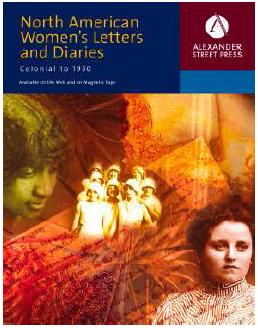
The database creators had strict criteria for deciding whether to include material:
- Authors must be women and must have been resident in North America for a significant time.
- Materials must have been written contemporaneously. Autobiographical material are excluded, unless they are considered of particular value.
- Memoirs are included when they are of particular value.
- Collections of letters begun before 1950 are included until they are complete. Collections of letters written after 1950 are excluded.
- Diaries that began before 1950 are included until they are complete. Diaries that began after 1950 are excluded.
- Letters written by men are excluded.
Using the database
There is a variety of ways to access the material within the database. In the top menu bar are the options to browse, find and search. The first few browse options and the simple search are pretty straightforward (browse by author, source, year, and simple full-text keyword search with some options to limit your results by author, year, document type etc), however this database offers some really nice other search/browse options that provide a different way to find material.
Under browse you will find options to browse by place (which also demonstrates that the material in this database has a much wider geographical interest than just North America, even if the authors are all American), historical events (eg Salem Witch Trials, Lincoln's assassination, the sinking of the Titanic), and personal events (death of child, emigration, religious experience, starting a job). There is also a showcase of a few selected documents of interest.
The difference between find and search is basically whether you are trying to find documents themselves, or search within them. Under 'find' you have the option to search for sources (ie, the documents) or authors. Searching for sources will only search on the bibliographic information attached to that document, and will bring you to the record (from where you can click through to the full text). Searching for authors is useful both when you're trying to find a known author (for which there is also an alphabetical browse index at the top of the search screen), and if you're trying to find authors that match certain criteria - ie, from a certain time period, place, ethnicity, religion etc. By each search box in all the different search screens is a 'terms' button, which will bring up a list of all the terms available in the index that you can select and add to your search - this also effectively offers you another way to browse, or restrict your search to specific subsets of the database.
The search menu options allow you to search within the text of the documents. As well as the usual simple and advanced search options, there are also options to specifically search either letters or diaries, and each search can be limited by a whole variety of different terms. The advanced search is particularly good if you want to search for something very specific (eg, restricting your search to letters written on military bases). The advanced search option also allows you to specify a proximity range for more than one search term. These incredibly detailed search options are a particular strength of this resource.
Where this resource is not quite so amazing is in what you can do with the results when you get them. Most of the documents are available only as transcriptions, not page images, although there are some page images available. There also aren't any save, export, or print options, so all you can really do is copy & paste or print directly from your browser (though bear in mind the fact that most of the material is still under copyright, so fair dealing principles apply). You can however easily click through from the bibliographic records to other documents by the same author or in the same source, as well as access the author's biography (where available).
For more information about this resource, see the publisher's description at: http://alexanderstreet.com/products/nwld.htm.
Friday, 18 February 2011
African American History Resources, Part One: 20th Century
February is Black History Month, and so I thought I'd put together a couple of blog posts about some of the resources we have available in the library for African American history. Resources for African American history are increasingly a particular strength of the VHL's collection, and with our recent acquisition of the electronic archives of two major black newspapers of the 20th century (The New York Amsterdam News, 1922-1993 and The Pittsburgh Courier, 1911-2002 - see this blog post for more information), we are now the only institution in Western Europe to have access to the archives of three black newspapers. In this first blog post I will focus on 20th century African American history resources, in particular relating to civil rights, and will follow it up (by the end of the month, I promise!) with one on the 19th century and slavery & emancipation.
Newspapers
To start briefly with newspapers and periodicals (but not too extensively, as they were the subject of my last two blog posts), in addition to the three archives mentioned above, we also have a collection of 17 black journals from the first half of the twentieth century available on microfiche (to see which, take a look at our online newspapers-on-microfilm list), as well as an extensive run of the leading African American magazine, Ebony, from 1945-1954 (on microfilm) and then 1958-2008 in print. If you're looking for really recent African American newspapers, then Ethnic NewsWatch (via OxLIP+) provides coverage of ethnic and minority newspapers from 1990 to the present.
For more information on finding newspapers in general, take a look at the previous two posts on this blog.
Microfilm collections
The Civil Rights Era is a particular strength of our collection, and we have several microfilm collections of papers and records relating to the Civil Rights struggle. The Congress of Racial Equality (CORE) Papers cover 1959-1976, and include the records and papers of this organisation, which was founded in 1942 in Chicago and advocated non-violent direct action to address racial discrimination. A guide to the microfilm collection can be found at Micr. E 185.61 .C75455 1984.
We only have selections of the Papers of the NAACP, but even so this is a massive collection of records, speeches, reports, correspondence, branch files and campaign information from the National Association of the Advancement of Colored People. We hold parts 1, 2, 11A, 11B, 12B, 12C, 12D, 26B, 26C, 26D, 28A, 28B, 29A, 29B, 29C, and 29D of this collection (along with guides), which cover a range of topics, locations and dates from 1909-1970.
Another substantial microfilm collection we hold is Civil rights during the Nixon Administration, which record the Nixon administration's broadening of the concept of equal rights beyond desegregation to include affirmative action in hiring women, the elderly, the physically disabled, and an expanding and overlapping list of other groups. Even though the subject matter here is much broader, you will still find records covering the continuing controversy over school desegregation and other topics relating to African American history.
And finally for microfilms, jumping back a little in time, are the Records of the Chicago Commission on Race Relations, which was set up following the riot of July/August 1919 by Illinois governor Frank Lowden.
Government publications and official papers
You can, as expected, find a huge amount of material in our major government publications resources, particularly of course the US Congressional Serial Set (via OxLIP+) where you can browse for publications related to acts such as the Civil Rights Acts of 1964 and 1968 and the Voting Rights Act of 1965, as well as search and browse by subject.
One thing you may not realise that we have though is a lot of the printed civil rights hearings, in particular those before the United States Commission on Civil Rights in the early 1960s - search for civil rights hearings on SOLO. Many of these are down in our stack, so you will need to place a stack request via OLIS to get them fetched up for you.
I will write further blog posts in the future about finding government publications, so keep an eye on the blog for that if you need more guidance.
Books
Just a quick note that the shelfmark range for African Americans in the Library of Congress classification is E 184.5 - E185.98. Obviously you can search SOLO to find out what books we have, but if you want to go and browse the shelves, that's where to head for!
Online resources
As ever, there is a huge and growing amount of fantastic primary source material being made available online. A good starting point is the VHL's delicious page, and the sites we have saved there tagged as African American: http://www.delicious.com/vhllib/African_American. Some particular highlights for the 20th century/civil rights are:
- Martin Luther King, Jr. Papers (Stanford University)
- Voices of Civil Rights
- Civil Rights Digital Library
- We Ain't What We Ought To Be: This is a tie-in website for the recently-published book by Stephen Tuck, and includes links to all sorts of free web resources relating to African American history from 1861 to the present that are referred to in the book.
- Documenting the American South
- Civil Rights in Mississippi Digital Archive
- Brown v Board of Education Online Archive
- Martin Luther King Online Encyclopedia
- Television News of the Civil Rights Era
- Black History on Footnote.com: all freely available with basic registration.
Wednesday, 8 December 2010
December 7, 1941: Japanese Attack on Pearl Harbor
One thing I thought might be fun to do on occasion on this blog is to showcase some individual documents from our various resources that tie in with events and days in history. Yesterday was the 69th anniversary of the Japanese attack on Pearl Harbor, and today is the anniversary of the USA's declaration of war on Japan and entry into World War II (mutual declarations of war with Germany and Italy followed a few days later). I've had a look through some of our e-resources to see what I could find relating to the Pearl Harbor attack, as follows:
Newspapers and contemporary reports
We have electronic access to the archives of both the New York Times and the Washington Post. You can search them individually or both at once, if you select them both on the first screen you come to after clicking through from OxLIP+. Searching both for December 8, 1941 brings up a large number of articles and editorials, and you can also get to images of the front pages of both papers from that day.

Link to full page image (Oxford users only)

Link to full page image (Oxford users only)
The official response
The US Congressional Serial Set is our major e-resource for US government publications. I'll write in more detail about it in forthcoming blog posts, but it contains all the reports and documents submitted to Congress from 1817-1994. A search for 'Pearl Harbor' and '1941' brings up both the House and Senate Documents from the Joint Session where President Roosevelt addressed Congress and requested that they declare war:

Serial Set Vol. No. 10599, Session Vol. No.22
77th Congress, 1st Session
H.Doc. 453
State of war between the United States and the Japanese empire. Address from the President of the United States before a joint session of the two houses of Congress requesting that Congress declare that there exists a state of war between the United States and the Japanese empire. December 8, 1941.
Link to access the full document from the Congressional Serial Set (Oxford users only)
The President's address can also be found in the Congressional Record, along with the resolution to declare war and the record of the proceedings in the Joint Session. We don't have the Congressional Record as an electronic resource, but the print volumes are all held in the library - the volume that includes the proceedings on December 8th is v.87, pt.24. The Senate record also includes various newspaper editorials in response to the attack that were entered into the record at the request of Senator Bridges. This is the kind of material that is sometimes additionally found in the Congressional Record that you might not otherwise expect or be able to get hold of here in Oxford, as we don't have holdings of many US newspapers for the 20th century.
Another Pearl Harbor-related document that you can find in the Serial Set is the report of the commission appointed by the President to investigate the attack, which was submitted to the Senate in January 1942.

Serial Set Vol. No. 10676, Session Vol. No.8
77th Congress, 2nd Session
S.Doc. 159
Attack upon Pearl Harbor by Japanese armed forces. Report of the commission appointed by the President of the United States to investigate and report the facts relating to the attack made by Japanese armed forces upon Pearl Harbor in the Territory of Hawaii on December 7, 1941.
Link to access the full document from the Congressional Serial Set (Oxford users only)
On the web: Eyewitness accounts and more
As ever, there is a huge amount of material available on the internet, including eyewitness accounts, oral histories, documents and images of all sorts. Here's just a sample of things available on the web related to the Pearl Harbor attack:
For more links to freely available web resources, take a look at the VHL's delicious page.
Newspapers and contemporary reports
We have electronic access to the archives of both the New York Times and the Washington Post. You can search them individually or both at once, if you select them both on the first screen you come to after clicking through from OxLIP+. Searching both for December 8, 1941 brings up a large number of articles and editorials, and you can also get to images of the front pages of both papers from that day.


The official response
The US Congressional Serial Set is our major e-resource for US government publications. I'll write in more detail about it in forthcoming blog posts, but it contains all the reports and documents submitted to Congress from 1817-1994. A search for 'Pearl Harbor' and '1941' brings up both the House and Senate Documents from the Joint Session where President Roosevelt addressed Congress and requested that they declare war:

Serial Set Vol. No. 10599, Session Vol. No.22
77th Congress, 1st Session
H.Doc. 453
State of war between the United States and the Japanese empire. Address from the President of the United States before a joint session of the two houses of Congress requesting that Congress declare that there exists a state of war between the United States and the Japanese empire. December 8, 1941.
Link to access the full document from the Congressional Serial Set (Oxford users only)
The President's address can also be found in the Congressional Record, along with the resolution to declare war and the record of the proceedings in the Joint Session. We don't have the Congressional Record as an electronic resource, but the print volumes are all held in the library - the volume that includes the proceedings on December 8th is v.87, pt.24. The Senate record also includes various newspaper editorials in response to the attack that were entered into the record at the request of Senator Bridges. This is the kind of material that is sometimes additionally found in the Congressional Record that you might not otherwise expect or be able to get hold of here in Oxford, as we don't have holdings of many US newspapers for the 20th century.
Another Pearl Harbor-related document that you can find in the Serial Set is the report of the commission appointed by the President to investigate the attack, which was submitted to the Senate in January 1942.

Serial Set Vol. No. 10676, Session Vol. No.8
77th Congress, 2nd Session
S.Doc. 159
Attack upon Pearl Harbor by Japanese armed forces. Report of the commission appointed by the President of the United States to investigate and report the facts relating to the attack made by Japanese armed forces upon Pearl Harbor in the Territory of Hawaii on December 7, 1941.
Link to access the full document from the Congressional Serial Set (Oxford users only)
On the web: Eyewitness accounts and more
As ever, there is a huge amount of material available on the internet, including eyewitness accounts, oral histories, documents and images of all sorts. Here's just a sample of things available on the web related to the Pearl Harbor attack:
- World War II diaries (Footnote.com): Footnote.com is a subscription website, but regularly makes parts of its collections free for a month at a time. For December, they have opened up their World War II diaries collection. Most of the content starts in 1942, but it does include this eyewitness account of the 1941 attack.
- Hawaii War Records Depository Photos: a wealth of digitised photographs documenting the impact of World War II in Hawaii, which were deposited at the Hawaii War Records Depository at the University of Hawaii. The collection includes 86 images related to the Pearl Harbor attack.
- Japanese American Relocation Digital Archives (University of California): Not about the attack per se, but this online archive contains a huge number of images (photographs, paintings and drawings) and some documents relating to the internment of Japanese Americans following the attack.
- Various oral histories can also be found on YouTube, and even some old film footage, such as the video embedded below.
For more links to freely available web resources, take a look at the VHL's delicious page.
Monday, 29 November 2010
American Founding Era Collection
For the first proper post on this blog, I thought I'd start with a resource that we don't actually own yet, but which we are currently trialling. We have access to the American Founding Era Collection from the University of Virginia Press until 3rd January 2011, and so if this is your period, I'd encourage you to make the most of this resource while we do. We would like to be able to purchase it permanently, funds-permitting, and if you'd like us to do so, then lots of usage and positive feedback would be great!
UPDATE: We have now purchased this resource.

The American Founding Era Collection contains digital versions of the published papers of several major figures of the time. The collections it contains are as follows:
Note on the Adams Papers: The Founding Era Collection only contains these papers from the founding-generation of the Adams family, and so the bulk of the papers available date from the 18th century.
Note on the Dolley Madison Digital Edition: This is the first ever complete edition of all Dolley Madison's correspondence. This collection was 'born digital', and is currently complete up to 1837. It is included in and can be accessed via the Founding Era Collection, but also has a separate platform, the one on which it was originally built, which also includes annotations that aren't accessible from the Founding Era platform. There are links across to the standalone platform from each document in the Founding Era Collection so that these annotations can be found easily.
How to use the database
As well as the full-text search, the browsing options are very powerful. You can browse collections individually or the whole lot at once, and have a choice of doing so by chronology (date of document) or by contents (order of the documents in the published volumes). There are also browsable indexes available to the Adams, Jefferson, and Washington Papers.

Once you have started browsing any of the contents, chronology, indexes or your search results, there is a navigation compass to take you forward and back through the different levels and documents. It looks a bit like part of the background (at least, I didn't realise what it was at first!), so in case it's not just me that overlooked it, I thought it was worth pointing out. The platform's own guide describes how the compass works as follows:
The documents themselves are transcribed, not page images, and contain links to notes, explanatory references and other documents where relevant. You can print documents, but there are no options for exporting/saving records other than to make a note of the durable URL given in the citation box at the bottom of each document. This box is a useful addition though, giving you guidance on how to cite the document in bibliographies, which can often be tricky to know how to do for online resources.
The collections are still being added to, as the print publication projects are still ongoing. This is of course less relevant for Oxford users at the moment, as we will lose access after 3rd January, but if we do purchase the collection then it will continue to grow from what is currently available. There is also a complementary project, Founders Early Access, which is freely available online (and therefore available to Oxford users even after 3rd January) as well as accessible within the main site. The Early Access collection contains documents that are in the process of being prepared for both print and online publication. Once the documents are added to the main collection, they disappear from the Early Access site, but whether we do purchase the entire collection or not, it's useful to know that you can access unpublished papers here. The link for the Early Access collection is: http://rotunda.upress.virginia.edu/founders/FOEA.html and you can keep up with updates to it at http://rotunda.upress.virginia.edu/founders/FOEA-history.html. It might also be worth pointing out that the University of Virginia is working with the National Archives to make some of the Founders' papers freely available online from 2012.
The American Founding Era Collection is accessible via OxLIP+, and as a trial it is currently listed on the front page. If you are away from Oxford, you can get into the database as long as you sign in via SOLO/OxLIP+ first with your University single sign-on.
UPDATE: We have now purchased this resource.

The American Founding Era Collection contains digital versions of the published papers of several major figures of the time. The collections it contains are as follows:
- The Adams Papers
- The Papers of Thomas Jefferson
- The Dolley Madison Digital Edition
- The Papers of James Madison
- The Papers of George Washington
- The Documentary History of the Ratification of the Constitution
Note on the Adams Papers: The Founding Era Collection only contains these papers from the founding-generation of the Adams family, and so the bulk of the papers available date from the 18th century.
Note on the Dolley Madison Digital Edition: This is the first ever complete edition of all Dolley Madison's correspondence. This collection was 'born digital', and is currently complete up to 1837. It is included in and can be accessed via the Founding Era Collection, but also has a separate platform, the one on which it was originally built, which also includes annotations that aren't accessible from the Founding Era platform. There are links across to the standalone platform from each document in the Founding Era Collection so that these annotations can be found easily.
How to use the database
As well as the full-text search, the browsing options are very powerful. You can browse collections individually or the whole lot at once, and have a choice of doing so by chronology (date of document) or by contents (order of the documents in the published volumes). There are also browsable indexes available to the Adams, Jefferson, and Washington Papers.

Once you have started browsing any of the contents, chronology, indexes or your search results, there is a navigation compass to take you forward and back through the different levels and documents. It looks a bit like part of the background (at least, I didn't realise what it was at first!), so in case it's not just me that overlooked it, I thought it was worth pointing out. The platform's own guide describes how the compass works as follows:
It took me a bit of getting used to, but once you've got your head round the structure of the collection, it is an easy way to move from one part to another. Next to it you always see where you are in the hierarchy.The navigation compass can be used to move between different places in the current view. The up and down arrows are used to move up and down within the hierarchy. For example, starting at the top of the contents view and repeatedly clicking the down arrow takes you from the publication to a series to a volume and so on down to individual documents. For the chronology view, doing the same thing takes you from decade to year to month to day to documents within that day. The left and right arrows are used to navigate between adjacent items at the same hierarchical level. Thus, if you are in the level corresponding to volumes of a publication, then clicking the left or right arrow takes you to the preceding or following volume, respectively. Again, if you are at the months level of the chronological hierarchy, then clicking the left or right arrows takes you to the preceding or following month.

The documents themselves are transcribed, not page images, and contain links to notes, explanatory references and other documents where relevant. You can print documents, but there are no options for exporting/saving records other than to make a note of the durable URL given in the citation box at the bottom of each document. This box is a useful addition though, giving you guidance on how to cite the document in bibliographies, which can often be tricky to know how to do for online resources.
The collections are still being added to, as the print publication projects are still ongoing. This is of course less relevant for Oxford users at the moment, as we will lose access after 3rd January, but if we do purchase the collection then it will continue to grow from what is currently available. There is also a complementary project, Founders Early Access, which is freely available online (and therefore available to Oxford users even after 3rd January) as well as accessible within the main site. The Early Access collection contains documents that are in the process of being prepared for both print and online publication. Once the documents are added to the main collection, they disappear from the Early Access site, but whether we do purchase the entire collection or not, it's useful to know that you can access unpublished papers here. The link for the Early Access collection is: http://rotunda.upress.virginia.edu/founders/FOEA.html and you can keep up with updates to it at http://rotunda.upress.virginia.edu/founders/FOEA-history.html. It might also be worth pointing out that the University of Virginia is working with the National Archives to make some of the Founders' papers freely available online from 2012.
The American Founding Era Collection is accessible via OxLIP+, and as a trial it is currently listed on the front page. If you are away from Oxford, you can get into the database as long as you sign in via SOLO/OxLIP+ first with your University single sign-on.
Subscribe to:
Posts (Atom)